Federal Bureau of Investigation
Where'd You Go BernadetteThe Federal Bureau of Investigation is the agency that exposes the identity-theft scheme concealed behind Bernadette Fox’s online assistant, “Manjula.” Its intervention transforms a private exchange of emails into a matter of financial fraud and possible physical danger to the Branch family. The agency’s documents supply concrete evidence for Elgin Branch’s alarm, but they also place criminal investigation inside a family conflict already moving toward involuntary treatment.
The investigation and the stolen information
The Federal Bureau of Investigation’s involvement reaches Elgin through a letter from Marcus Strang, who identifies himself as regional director of the Internet Crime Complaint Center, working in partnership with the Department of Homeland Security. His department tracks advance-fee schemes and identity fraud. The inquiry began with a $40 Visa charge dated October 13 to Delhi Virtual Assistants International. Strang says the company does not exist and describes it as a shell company for a crime syndicate operating out of Russia. Investigators had spent six months building a case and had obtained a warrant a month before the letter, allowing them to track emails between Bernadette and someone using the name Manjula.
The emails reveal the scale of the exposure: Bernadette had provided credit-card details, bank-wiring instructions, Social Security numbers, driver’s-license numbers, addresses, passport numbers, and photographs of herself, Elgin, and their daughter, Bee Branch. The disclosure was not simply that the supposed assistant was fraudulent; the correspondence had made the family’s identities and financial information available to the scheme. Strang adds that Bernadette had written that Elgin forbade her to use the service, suggesting that he did not know she continued to communicate with it.
The agency’s warning becomes more urgent when Strang reports that Manjula requested power of attorney while Elgin and Bee would be away on their planned trip. Investigators intercepted the request before it reached Bernadette. Based on her previous conduct, Strang believed she would sign it without hesitation. He characterized the matter as delicate and urgent, said he was landing in Seattle, Washington, and asked Elgin to meet him at the Microsoft Visitor Center at noon and cooperate fully. He also instructed Elgin not to share the information during the next three hours, especially not with Bernadette, whom he described as an unreliable actor. The letter thus gives Elgin both a warning and a restrictive instruction at a moment when the people most affected by the fraud are not equally informed.
From digital fraud to a physical threat
At the Branch residence, Strang supplies further details that change the apparent scale of the danger. Manjula had stolen Elgin’s American Airlines miles, and the miles had been used to buy a one-way ticket from Moscow to Seattle, Washington, for a flight arriving the next day. The impostor had also emailed Bernadette asking her to confirm that she would be alone in the house while Elgin and Bee were away. Those facts connect the online fraud to a possible approach to the family’s home, although the available account does not establish what the visitor intended to do.
Strang explains that investigators had initially underestimated the threat because internet thieves usually do not leave their basements, much less board planes. That judgment proved unsafe once the stolen miles purchased actual travel. Elgin is so shocked by the new information that he needs a wall for support. Soo-Lin Lee-Segal, his administrator, rubs his back and assures him that Bernadette will be safe at Madrona Hill. Dr. Janelle Kurtz immediately qualifies that reassurance: she has not evaluated Bernadette and therefore cannot guarantee that she can be placed on an involuntary hold. The FBI’s discovery has exposed a risk, but it has not resolved who can legally protect Bernadette or how.
The agency inside the family intervention
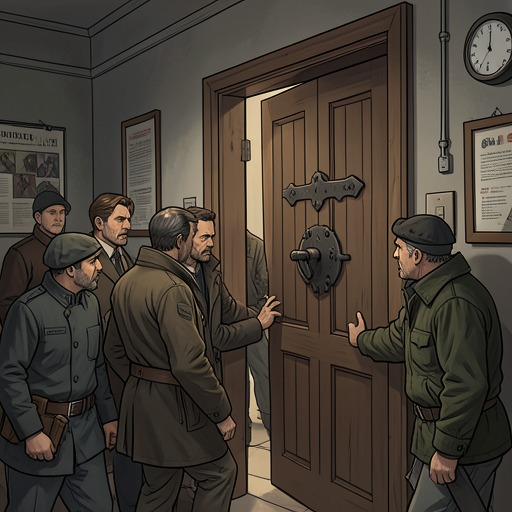
Strang is present when the planned intervention begins. Elgin asks him to explain the havoc Bernadette’s actions have caused; Strang declines to turn his law-enforcement appearance into participation in the family confrontation, saying that an intervention is outside his role. His refusal marks a practical limit on the FBI’s authority: the agency can investigate the identity-theft ring and relay evidence, but the scene’s treatment decisions belong to another process.
Elgin nevertheless uses the agency’s findings to explain the situation to Bernadette. He says that Manjula is an alias used by an identity-theft ring operating out of Russia, that the criminals have been collecting the family’s banking information, and that they are coming to Seattle, Washington while he and Bee are away. Strang confirms the account in qualified terms. Bernadette first says she does not believe it, then corrects herself to say that she does believe it and asks what the criminals intend to do. The exchange shows the FBI information entering the family’s argument not as an abstract case file but as evidence with immediate consequences for the trip and the home.
The criminal investigation also becomes part of Elgin’s case for seeking psychiatric care for Bernadette. In Dr. Kurtz’s account of their meeting, Elgin believes the FBI file provides adequate proof to qualify his wife for inpatient treatment. Kurtz is concerned by his determination to use an involuntary hold; she explains that adjustment disorder calls for psychotherapy, not a psychiatric hold, and that it would be unethical to place someone on such a hold without meeting her first. The FBI material can substantiate fraud and risk, but it does not, by itself, meet the clinical or legal requirements for involuntary treatment.
Documentary role and limits
The Federal Bureau of Investigation is presented largely through documents and reported findings: Strang’s letter, the warrant-backed monitoring of email, and the later account delivered at the Branch residence. This form makes the investigation legible through dates, a charge amount, categories of stolen data, and a specific intercepted request. Each detail narrows the distance between an apparently ordinary online service and an organized criminal scheme. At the same time, the documents are not a complete account of Bernadette’s motives or state of mind; their purpose is to establish the fraud and warn Elgin, not to explain every aspect of her behavior.
The agency’s portrayal also contains a consequential reversal. Investigators had treated the threat as less serious because online criminals rarely travelled, yet the stolen miles enabled a one-way flight from Moscow. Their information is indispensable to the family’s understanding of the danger, but it arrives amid the secrecy surrounding Elgin’s plans and the contested effort to detain Bernadette. The FBI therefore functions both as a source of verified evidence and as one institution among several whose knowledge and authority do not settle the family crisis. Its findings reveal what the impersonator has done; they do not decide how Bernadette should be treated, guarantee her safety, or restore the privacy the family has already lost.